
[ad_1]
Backblaze is a backup and cloud storage company that has been tracking the annualized failure rates (AFRs) of the hard drives in its datacenter since 2013. As you can imagine, that’s netted the firm a lot of data. And that data has led the company to conclude that HDDs “are lasting longer” and showing fewer errors.
That conclusion came from a blog post this week by Stephanie Doyle, Backblaze’s writer and blog operations specialist, and Pat Patterson, Backblaze’s chief technical evangelist. The authors compared the AFRs for the approximately 317,230 drives in Backblaze’s datacenter to the AFRs the company recorded when examining the 21,195 drives it had in 2013 and 206,928 drives in 2021. Doyle and Patterson said they identified “a pretty solid deviation in both age of drive failure and the high point of AFR from the last two times we’ve run the analyses.”
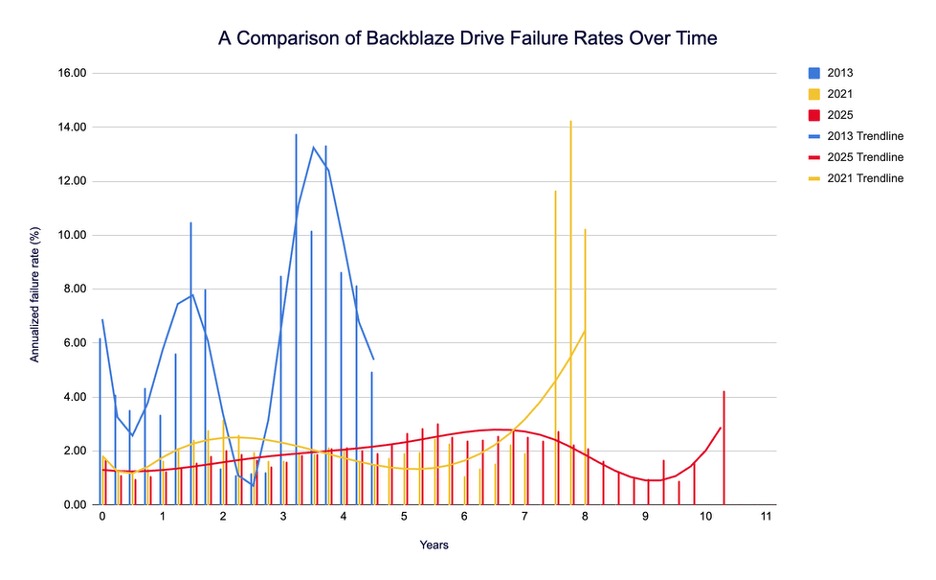
As Doyle and Patterson wrote, the tested drives’ high failure percentage peaks this year were 4.25 percent at 10 years and three months, compared to 13.73 percent at about three years and three months in 2013 and 14.24 percent at seven years and nine months in 2021.
“Not only is that a significant improvement in drive longevity, it’s also the first time we’ve seen the peak drive failure rate at the hairy end of the drive curve. And, it’s about a third of each of the other failure peaks,” Doyle and Patterson wrote.
You can check out Paterson and Doyle’s August blog post for more information about the drives they analyzed this year. The drives were from HGST, Seagate, Toshiba, and WDC, and they had an average age of 3.7 months to 103.9 months (about 8.7 years). The drives ranged from 4TB to 24TB. In 2021, Backblaze’s sample had drives from the same vendors, and the drives tested for each model had an average age of 3.57 to 80.85 months (about 6.7 years). The drives ranged from 4TB to 16TB.
As Backblaze has done in the past, Doyle and Paterson compared the behaviors of Backblaze’s datacenter HDDs with the bathtub curve, an engineering principle that says component failure rates tend to follow a U-shape over time, with more failures occurring early in life before the rate drops, settles, and then picks up again as the component ages.
[ad_2]
Source link