
[ad_1]
Turnover at the top of the company isn’t stopping Intel from launching new products: Today the company is announcing the first of its next-generation B-series Intel Arc GPUs, the Arc B580 and Arc B570.
Both are decidedly midrange graphics cards that will compete with the likes of Nvidia’s GeForce RTX 4060 and AMD’s RX 7600 series, but Intel is pricing them competitively: $249 for a B580 with 12GB of RAM and $219 for a B570 with 10GB of RAM. The B580 launches on December 13, while the B570 won’t be available until January 16.
The two cards are Intel’s first dedicated GPUs based on its next-generation “Battlemage” architecture, a successor to the “Alchemist” architecture used in the A-series cards. Intel’s Core Ultra 200 laptop processors were its first products to ship with Battlemage, though they used an integrated version with fewer of Intel’s Xe cores and no dedicated memory. Both B-series GPUs use silicon manufactured on a 5 nm TSMC process, an upgrade from the 6 nm process used for the A-series; as of this writing, no integrated or dedicated Arc GPUs have been manufactured by one of Intel’s factories.
Both cards use a single 8-pin power connector, at least in Intel’s reference design; Intel is offering a first-party limited-edition version of the B580, while it looks like partners like Asus, ASRock, Gunnir, Maxsun, Onix, and Sparkle will be responsible for the B570.
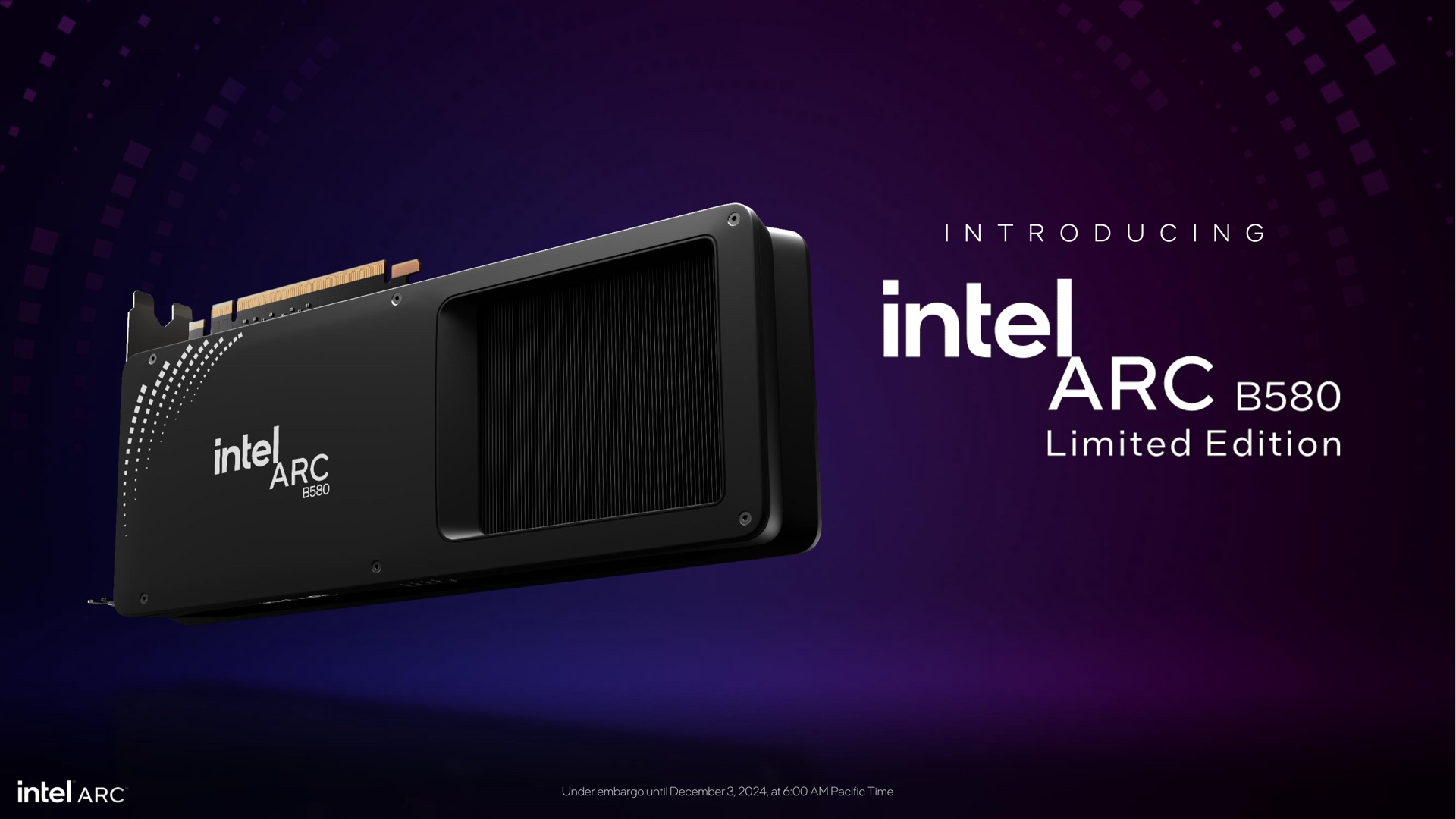
Intel
The Arc B580 will be available in a limited-edition design from Intel.
Intel
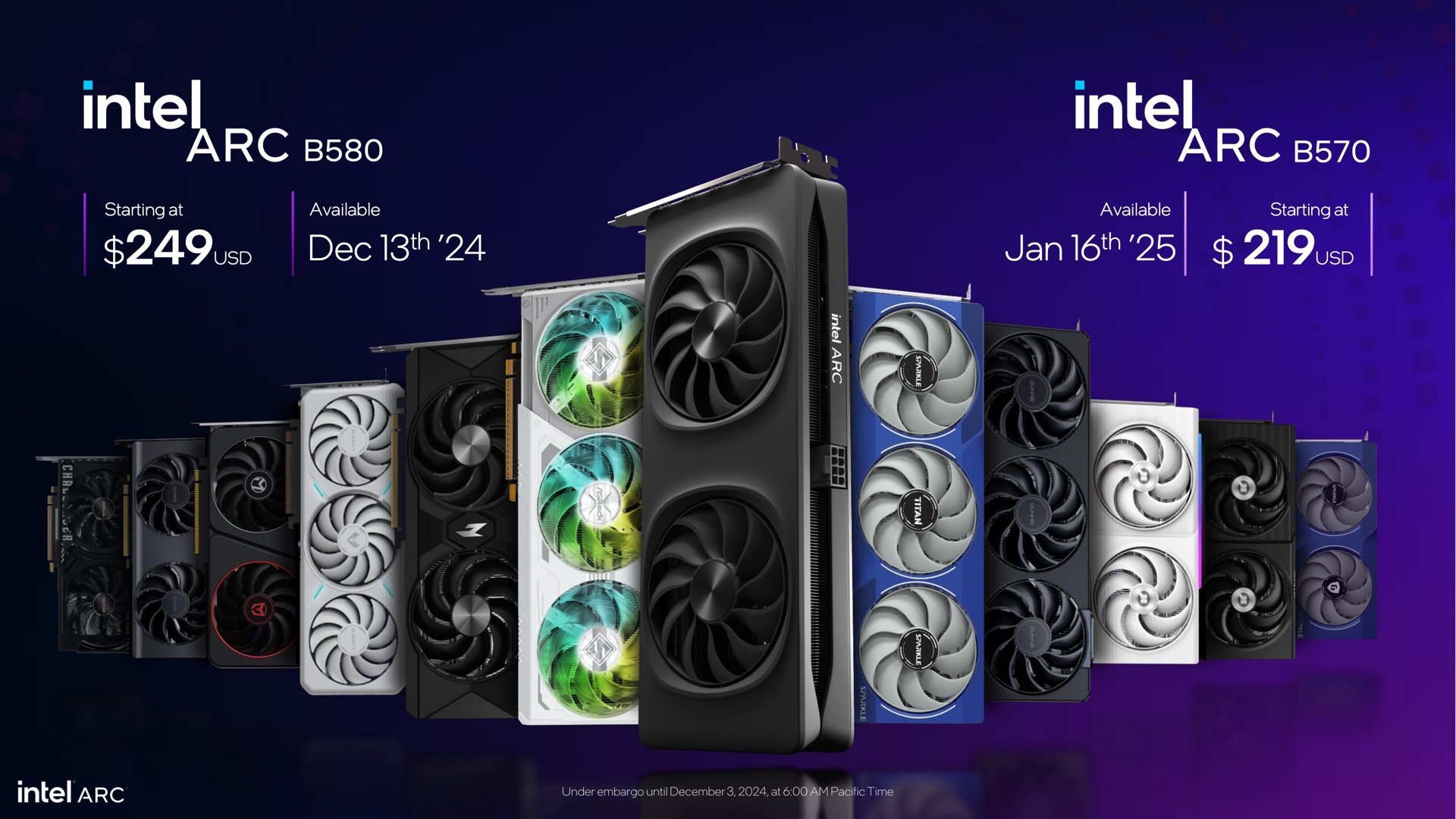
Intel
Intel’s partners will handle the other cards, including all versions of the B570. The B580 and B570 will launch for $249 and $219, respectively.
Intel
The Arc B580 will be available in a limited-edition design from Intel.
Intel
Intel’s partners will handle the other cards, including all versions of the B570. The B580 and B570 will launch for $249 and $219, respectively.
Intel
Compared to the original Arc GPUs, both Battlemage cards should benefit from the work Intel has put into its graphics drivers over the last two years—a combination of performance improvements plus translation layers for older versions of DirectX have all improved Arc’s performance quite a bit in older games since late 2022. Hopefully buyers won’t need to wait months or years to get good performance out of the Battlemage cards.
The new cards also come with XeSS 2, the next-generation version of Intel’s upscaling technology (analogous to DLSS for Nvidia cards and FSR for AMD’s). Like DLSS 3 and FSR 3, one of XeSS 2’s main additions is a frame-generation feature that can interpolate additional frames to insert between the frames that are actually being rendered by the graphics card. These kinds of technologies tend to work best when the cards are already running at a reasonably high frame rate, but when they’re working well, they can lead to smoother-looking gameplay. A related technology, Xe Low Latency, aims to reduce the increase in latency that comes with frame-generation technologies, similar to Nvidia’s Reflex and AMD’s Anti-Lag.
[ad_2]
Source link