
The Bank of Korea was the first to hold its rates steady after being the first to hike in the pandemic era — and could be the first to cut rates in the region.
Gw. Nam | Moment | Getty Images
One by one, countries in Asia-Pacific are putting a pause on their tightening cycles this year after central banks around the world tried to keep pace with the U.S. Federal Reserve’s aggressive rate hikes in 2022.
While inflation in the region remains well above central bank targets, the problem of balancing economic growth and the depreciating currencies — as a result of the U.S. dollar peak in September — appears to be easing for now.
related investing news

The dollar index is broadly weaker now on expectations the Fed could soon end its tightening cycle. Inflation is also seen to be less sticky in the region compared to the U.S. and Europe — BofA economists led by Helen Qiao said inflation in Asia’s emerging markets has already “peaked out and started to moderate in the region.”
In fact, economists say some central banks may have already reached the end of their tightening cycles and could begin to shift their focus to what will stimulate growth through rate cuts. Citi and ING are among those expecting to see such moves as soon as the second half of this year.
China and Japan are still outliers in the current global tightening cycle. Here are other central banks in the region that have hit the brakes for now — and what they could end up doing next.
South Korea
- Policy rate: 3.50%
- Consumer Price Index: +4.2% year-on-year in March
- Inflation target: 2%
- GDP (Q4 2022): +1.3% year-on-year, -0.4% quarter-on-quarter
- Next central bank decision: May 25
The Bank of Korea was the first to hold rates steady after being one of the first nations to hike in the pandemic era — and could even become the first to cut rates in the region.
Central bank governor Rhee Chang-yong pushed back on expectations of a rate cut later this year, as the Bank of Korea held its rates steady twice after seven consecutive hikes in 2022.
Economists at Citi and ING are among those taking that outlook with a grain of salt. They expect the BOK to cut rates as inflation falls back to target and the extent of the economic damage from its tightening cycle emerges.
Citi economist Choi Ji-uk said in an April 12 note, “BoK will likely begin a rate cutting cycle in August’23 towards 2.00% by the end of 2024, assuming the level of neutral real rate and the inflation target at 2%.”

ING economist Min Joo Kang said, “We think the demand-side pressure will likely turn soft as the restrictive policy environment weighs on consumption and the real economy, meanwhile external demand conditions will improve only gradually in the second half,” according to an April 11 note.
Australia
- Policy rate: 3.60%
- Consumer Price Index: +7.8% year-on-year in Q4 2022
- Inflation target: 2% to 3%
- GDP (Q4 2022): +2.7% year-on-year, +0.5% quarter-on-quarter
- Next central bank decision: May 2
The Reserve Bank of Australia defied market expectations of another hike in March when the central bank held its cash rate target steady at 3.60% – it marked the first halt since starting its tightening cycle in May 2022. Its cash rate is at the highest since May 2012.
The central bank, similar to South Korea’s, pushed back against closing the door completely on further rate hikes. In fact, it explicitly noted that further tightening is still needed.
“The Board expects that some further tightening of monetary policy may well be needed to ensure that inflation returns to target,” the RBA said in a statement.
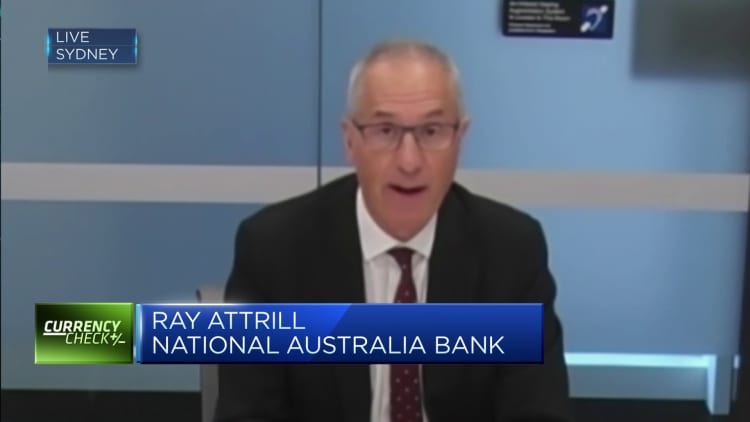
“Our view is that the data flow will continue to disappoint to the downside in coming months and further rate rises won’t be justified,” economist Diana Mousina of AMP said in a note on April 4, adding she expects the RBA to start cutting by the end of the year.
India
- Policy rate: 6.5%
- Consumer Price Index: +5.66% year-on-year in March
- Inflation target: Around 4% (2% to 6%)
- GDP (Q4 2022): Grew by 4.4% year-on-year, grew by 3.5% quarter-on-quarter
- Next central bank decision: Between June 6 to 8
The Reserve Bank of India held its policy repurchase rate at 6.5% at its last central bank policy meeting in April, despite economists’ expectations for the central bank to hike 25 basis points.
Central bank governor Shaktikanta Das said he expects inflation to moderate over the next 12 months, alongside the central bank lowering its inflation forecasts from 5.3% to 5.2% for the fiscal year starting in April.

Economists at JPMorgan and Societe Generale are among those that expect to see the RBI cut rates by 25 basis points to 6.25% by the fourth quarter of 2023 and another cut to 6.00% by the first quarter of 2024, Refinitiv data showed.
Southeast Asia
Central banks in Indonesia and Malaysia have all paused their rate hikes for now.
- Indonesia
Bank Indonesia has held its 7-day reverse repurchase rate steady at 5.75% in the last two meetings, saying the current rate is “sufficient to direct core inflation” to its target range of between 2% and 4% within 2023.
Citi economist Helmi Arman expects Indonesia to cut rates as soon as September this year.
“As the inflation outlook is also benign, we see policy rate cuts happening sooner,” Arman said in an April 12 note, adding he moved up his forecast for a cut in the first half of 2024 in light of recent economic data.
Indonesia’s consumer price index rose 4.97% in March. The central bank raised rates six times since August 2022, and its next monetary policy decision is due on April 18. - Singapore
The Monetary Authority of Singapore kept its monetary policy unchanged on Friday, and warned of dim growth ahead for the year in its statement.
The central bank said in its latest policy statement that it expects core inflation to average 3.5% to 4.5% for the whole of 2023.
“While inflation is still elevated, MAS’ five successive monetary policy tightening moves since October 2021 have tempered the momentum of price increases. The effects of MAS’ monetary policy tightening are still working through the economy and should dampen inflation further,” the Monetary Authority of Singapore said.
The central bank is due to release its next policy statement in October. - Malaysia
Bank Negara Malaysia held its overnight policy rate steady at 2.75% in March, after the economy saw robust growth in 2022 and grew 8.7% last year, “driven by the recovery in private and public sector spending following the full reopening of the economy.” The central bank hiked its rates four times since May 2022, according to Refinitiv.
Consumer price index rose 3.7% year-on-year in February. Malaysia’s inflation target is between 3% to 4%, according to Refinitiv data. The central bank’s next monetary policy meeting is on May 3.
No pause just yet…
However, there are still central banks in the region that have continued to raise interest rates, including New Zealand and Thailand.
The Bank of Thailand hiked its policy rate by 25 basis points to 1.75% at its March meeting, and said it sees a “continuation of gradual policy normalization to be appropriate in light of the growth and inflation outlook.” Thailand’s central bank meets again on May 31.

