[ad_1]
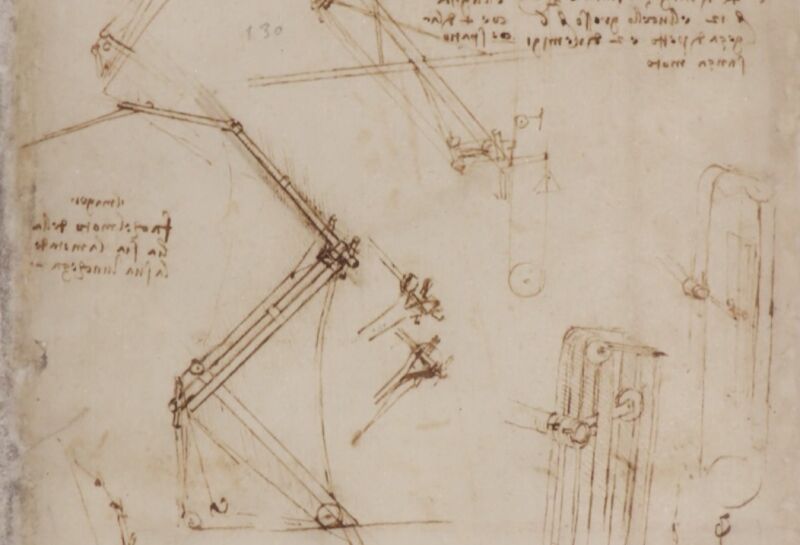
Veneranda Biblioteca Ambrosiana, Milan
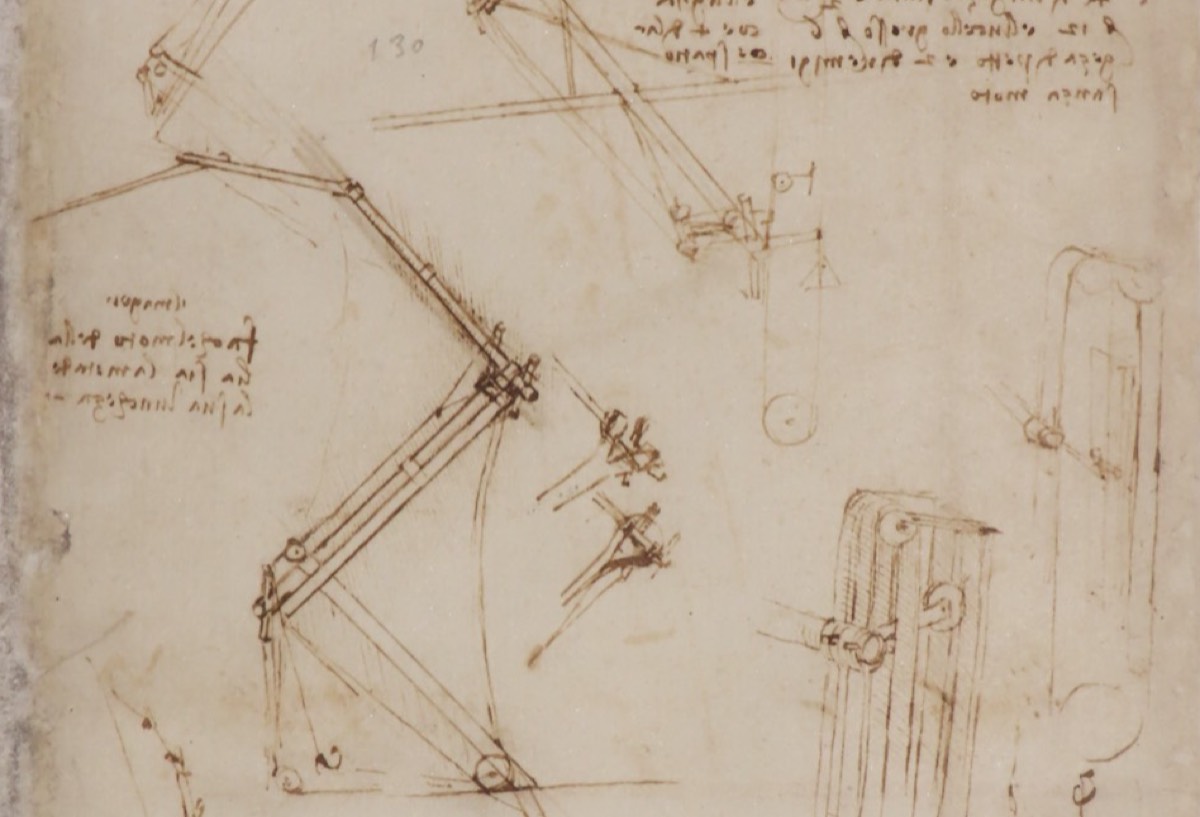
Researchers at the Politecnico di Milan in Italy examined mysterious black stains on a folio of Leonardo da Vinci‘s Codex Atlanticus and confirmed the presence of starch and vinyl glues in the affected areas. The glues were most likely applied during an earlier restoration effort some 50 years ago, according to a recent paper published in the journal Scientific Reports. They also identified a likely cause of the dark stains: nanoparticles of a mercury sulphide called metacinnabar in the protective paper holding the folio, although it is unclear how this unusual black crystalline phase might have formed.
Da Vinci produced more than 13,000 pages in his notebooks (later gathered into codices), less than a third of which have survived. The notebooks contain all manner of inventions that foreshadow future technologies: flying machines, bicycles, cranes, missiles, machine guns, an “unsinkable” double-hulled ship, dredges for clearing harbors and canals, and floating footwear akin to snowshoes to enable a man to walk on water. The notebooks also contain da Vinci’s detailed notes on his extensive anatomical studies. Most notably, his drawings and descriptions of the human heart captured how heart valves can ebb blood flow 150 years before William Harvey worked out the basics of the human circulatory system.
The largest single set is the 12-volume Codex Atlanticus, in which (among other observations) da Vinci foresaw the possibility of constructing a telescope when he wrote of “making glasses to see the moon enlarged”—a century before the instrument’s invention. The codex was subjected to a major 10-year restoration effort from 1962 to 1972, in which each individual folio in the 12 volumes was framed by a “passe-partout”: a protective paper cover consisting of three modern paper layers glued to each folio so they could be more easily handled and displayed. It also enabled the double-sided documents to be read and examined. The codex is currently housed in the Biblioteca Ambrosia in Milan.
In April 2006, a representative from New York City’s Metropolitan Museum of Art was alarmed to discover what appeared to be red, black, and purple molds invading the Codex Atlanticus, as well as swelling of some of the pages—despite the fact that the codex had been stored in a carefully controlled micro-environment since 1997. A conservation institute in Florence, Italy, promptly launched an investigation.
The concern was well-founded. Studying the microbial species that congregate on works of art may lead to new ways to slow down the deterioration of priceless aging artwork. In fact, scientists analyzed the microbes found on seven of da Vinci’s drawings in 2020. Researchers at the University of Natural Resources and Life Sciences in Vienna, Austria, used a third-generation sequencing method known as Nanopore, which uses protein nanopores embedded in a polymer membrane for sequencing, and combined the Nanopore sequencing with a whole-genome-amplification protocol.
They found that each drawing had its own unique microbiome. But they were surprised to find that, overall, bacteria dominated fungi in the drawings’ microbiomes, contradicting widespread belief that fungi would be more dominant, given their higher potential to colonize on paper-based works. Much of those bacteria are typically found in human microbiomes, suggesting they found their way onto the drawings while being handled during restoration—although one could speculate about whether it came from the artist himself. (The Austrian/Italian team was unable to conclude definitively whether any of the microbial contaminants date back to da Vinci’s time.) Other bacteria were typical of insect microbiomes and may have been introduced long ago by flies depositing excrement on the drawings.
[ad_2]
Source link