
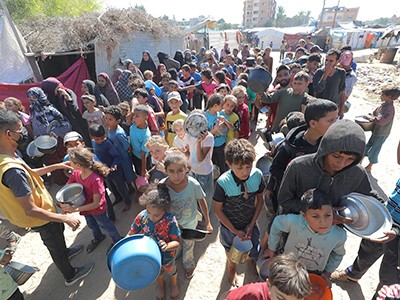
Displaced Palestinians gather to receive food at a charity kitchen in Gaza in December 2025.Credit: Eyad Baba/AFP via Getty
The collision of two trends should concern us all more: the world has been experiencing both a record number of active conflicts — 61 in 36 countries in 2024 — since the Second World War, and a decline in international aid.
Health of people who are displaced in their own countries is a neglected global crisis
In 2025, the administration of US President Donald Trump ordered the US Agency for International Development to be closed; this year, it withdrew the country from 66 international organizations. Other Western nations that are plagued with high levels of debt and pressure to prioritize domestic challenges have slashed their foreign aid, too. According to projections, official development assistance dropped by 9–17% in 2025, amounting to some US$55 billion, after a 9% decrease in 2024. Multilateral institutions, such as the United Nations and World Bank, have also embarked on drastic restructurings with lay-offs.
Meanwhile, conflicts are intensifying amid rising geopolitical tensions, in places as diverse as Gaza, Iran, Haiti, Myanmar, Sudan and Ukraine. The UN reports that 305 million people in conflict zones need urgent humanitarian aid; more than 123 million have been forcibly displaced, facing malnutrition and lack of shelter. The cost of rebuilding cities in Gaza and the West Bank has been put at $53 billion; in Syria, that number is at least $250 billion.
The unravelling of the aid industry must force a reset of the nexus between peace and economic development. The international-development model has changed little in eight decades. In 1949, at his inaugural address as US president, Harry Truman introduced a linear concept of development — in which countries progress from ‘under-developed’ to ‘developed’ — and recognized that poverty was a “threat” to both less- and more-prosperous areas. Since then, the proportion of the world’s population in extreme poverty has plummeted, from 50–60% to about 10%. Yet, conflicts have surged. Clearly the relationship between economic development and conflict is a complicated one, which is being explored in empirical research.
To ease the world food crisis, focus resources on women and girls
My own studies point to an asymmetry: it takes at least a decade for a society to rebuild after a conflict, whereas a burst of economic development (including that through aid) barely affects conflict intensity. Quantitatively, the half-life — or how long it takes the cumulative effect of a shock to decay by half — of the adverse effects of conflicts on development goals is around eight years. By contrast, shocks to development performance — be they improvements or deteriorations — exhibit only transient effects on conflict, with a half-life of around two years.
This finding challenges the premise that peace is a byproduct of economic development and carries sobering implications for the global aid industry.
In short, the aid industry should shift to a ‘peace first’ approach, with conflict prevention being its main concern. Considering the huge costs of war and long set backs to development, preventing conflicts from breaking out holds immense value. Peace-building requires investment in scientific approaches for assessing the risk of conflicts before they happen. Diplomacy, mediation and preventive security have higher long-term returns than previously recognized.
From that perspective, it is paradoxical that the UN, whose mission is to maintain peace and security, is under attack. The aid industry and other multilateral and development institutions should speak with one voice about the devastating effects of conflicts and show solidarity and commitment to peace building efforts worldwide.

