
Milkshakes and other fatty foods trigger activity in the brain’s orbitofrontal cortex, which is involved with reward processing.Credit: Mike Kemp/RubberBall/Alamy
Rich, high-fat foods such as ice cream are loved not only for their taste, but also for the physical sensations they produce in the mouth — their ‘mouthfeel’. Now scientists have identified a brain area that both responds to the smooth texture of fatty foods and uses that information to rate the morsel’s allure, guiding eating behaviour1.
These findings, published on 16 October in The Journal of Neuroscience, “add a new dimension” of the eating experience to scientists’ understanding of what motivates people to choose certain foods, says Ivan de Araujo, a neuroscientist at the Max Planck Institute for Biological Cybernetics in Tübingen, Germany, who was not involved in the study.
A tongue for texture
To explore how food textures influence eating habits, Fabian Grabenhorst, a neuroscientist at the University of Oxford, UK, and his colleagues set out to quantify the mouthfeel of fatty foods. The authors prepared several milkshakes with varying fat and sugar contents and placed a sample of each between two pig tongues procured from a local butcher. The researchers then slid the tongues across each other and measured the amount of friction between the two surfaces, providing a numerical index of each shake’s smoothness.
Habit-linked brain circuits light up in people with eating disorders
The researchers then gave 22 participants milkshakes with the same compositions as those tested on the pig tongues. After tasting each milkshake, participants placed bids on how much they would spend to drink a full glass of it after the experiment.
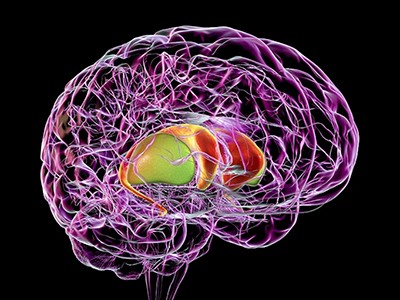
Accompanying brain scans showed that activity patterns in an area called the orbitofrontal cortex (OFC), which is involved in reward processing, reflected the shakes’ texture. The scans also identified OFC activity patterns that reflected participants’ bids, suggesting that this brain region links mouthfeel to the value placed on that food.
To find out whether this finding extends to food intake, the researchers invited the participants to return to the laboratory for a free lunch of several curry dishes with varying fat contents. Unbeknown to the participants, the researchers measured how much of each curry the participants ate. They found that those whose OFCs were most sensitive to fatty texture were more likely to eat more of the high-fat curry compared with those who weren’t as sensitive to fatty texture.
These findings could help to shape formulations of low-calorie foods and understand the neural mechanisms of overeating, Grabenhorst says.

