
Neutron-scattering experiments that helped to verify the quantum predictions were carried out at Oak Ridge National Laboratory, Tennessee. Credit: Oak Ridge National Laboratory
The hope for quantum computers is that the devices will be able to solve complex tasks such as predicting how chemicals react or cracking encrypted text. One of the main reasons that the machines are not yet living up to that potential is the fact that their error rates are high.
Now, for the first time, physicists have matched detailed simulations done on quantum computers to experimental data gathered from work with solid materials. The research shows how the results of quantum simulations can be tested with real-world data — a capability that will become increasingly important as these machines begin to make calculations that are beyond those that ordinary supercomputers can manage. Two teams achieved the results independently, and the work is described in two preprints posted on the arXiv server in the past two weeks. These are yet to be peer reviewed.
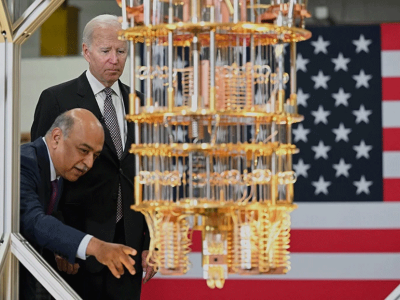
IBM quantum computer passes calculation milestone
The experiments were done with the explicit aim “to contrast the data with what we’re measuring in the quantum computer”, says Alexandre Dauphin, a physicist at a quantum-computing start-up called Pasqal in Paris and the lead author of one of the studies1.
Arnab Banerjee, a physicist at Purdue University in West Lafayette, Indiana, who led the second study2, says that cross-checks, or benchmarks, using real materials that can be extensively analysed in the laboratory are crucial “so you know what you are simulating really makes sense”.
Analog versus digital
The simulation of natural quantum phenomena — such as that underlying some materials’ ability to conduct electricity without any resistance — has long been described as one of the main potential applications of quantum computers. Researchers hope that using the computers as virtual laboratories will enable them to understand such phenomena, and will guide the creation of next-generation materials and chemicals, including drugs.
Dauphin and his collaborators simulated a magnetic material that contains the rare element thulium. The material has a crystal structure in which the atoms are unable to align their magnetic orientations in an ordered way, and was predicted to have complex patterns of quantum interactions. To mimic the physics of this crystal, the researchers used one of Pasqal’s ‘neutral atom’ quantum computers, which encode information in the quantum states of individual atoms held with laser light in ‘optical tweezers’. Using an approach called analog quantum simulation, the Pasqal quantum computer calculated properties such as the material’s heat capacity — how much energy it takes to increase the temperature of one gram by 1 ºC — and how it responds to changing magnetic fields.
Daniel González-Cuadra, a theoretical physicist at the Institute for Theoretical Physics in Madrid, says that benchmarking the model against experimental measurements of the actual materials is “sets the stage for a new standard in the application of quantum simulation to materials science.”

Results of a neutron-scattering experiment (left) and an IBM quantum-computer-aided simulation of the experiment (right).Credit: Y.-T. Lee et al./arXiv
Banerjee’s team simulated a different material, made of copper, fluorine and potassium, which also contains atoms that are not magnetically aligned. Like the material simulated by Dauphin’s team, this was predicted to have complex patterns of quantum interactions.
The team implemented a scheme called digital quantum simulation on an IBM quantum computer that stores information inside superconducting loops of metal instead of in individual atoms. The researchers simulated the material’s response to being excited into a range of energy states, as well as the appearance of ‘fractional’ electrons — in which the material’s electrons behave collectively as if they have only a portion of their regular magnetism (which would be impossible for a single particle).
Each simulation had different strengths, Dauphin and Banerjee say. Both teams compared their predictions with data from neutron-scattering experiments, which reveal hidden features of a material by analysing how neutrons scatter off it and how their energy changes.

