
[ad_1]
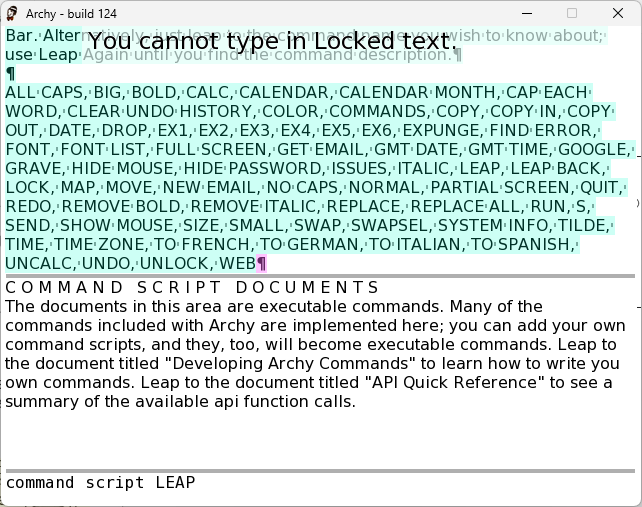
A list of commands in Archy.
Credit:
Cameron Kaiser
The COMMANDS verb gives you a list of commands (notice that Archy has acquired a concept of locked text, normally on a black background, and my attempt to type there brought me automatically to somewhere I actually could type). While THE’s available command suite was almost entirely specific to an editor application, Archy’s aspirations as a more complete all-purpose environment are evident. In particular, in addition to many of the same commands we saw on the Mac, there are now special Internet-oriented commands like EMAIL and GOOGLE.
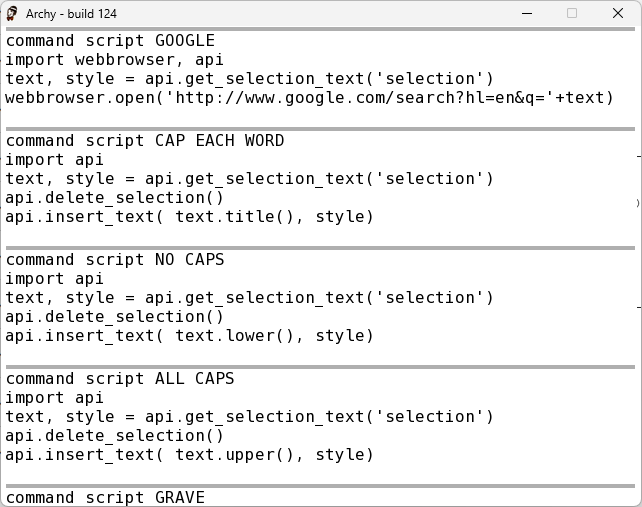
How commands in Archy are constructed.
Credit:
Cameron Kaiser
Unlike THE, where you had to edit them separately, commands in Archy are actually small documents containing Python snippets embedded in the same workspace, and Archy’s API is much more complete. Here is the GOOGLE command, which takes whatever text you have selected and turns it into a Google search in your default browser. In the other commands displayed here, you can also see how the API allows you to get and delete selected text, then insert or modify it.
Cameron Kaiser
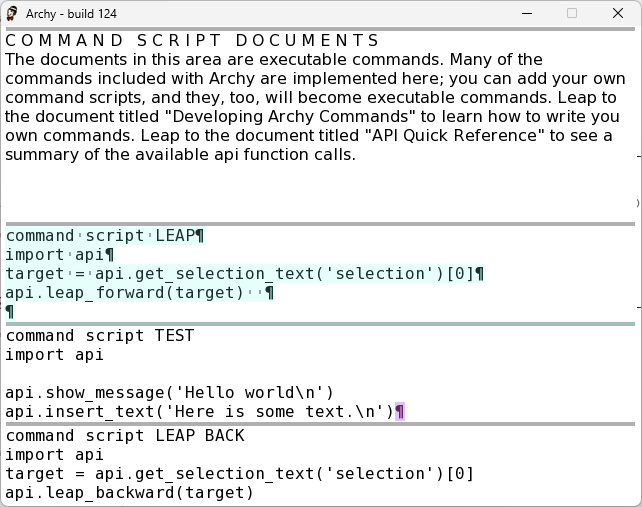
Creating a new command in Archy.
Cameron Kaiser
Cameron Kaiser
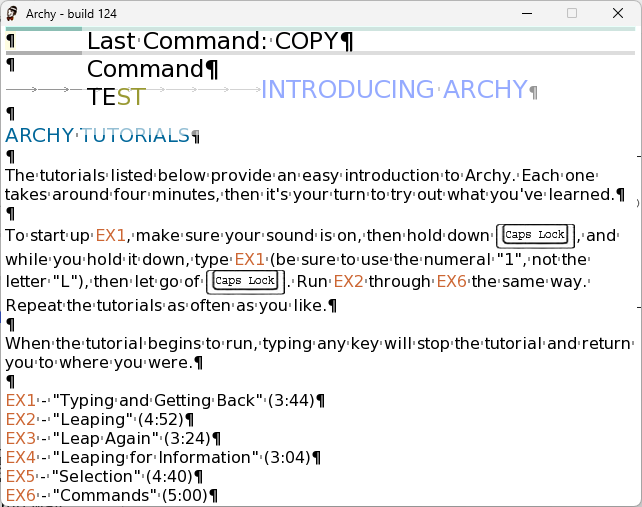
Running that command.
Cameron Kaiser
Cameron Kaiser
The results.
Cameron Kaiser
Running that command.
Cameron Kaiser
The results.
Cameron Kaiser
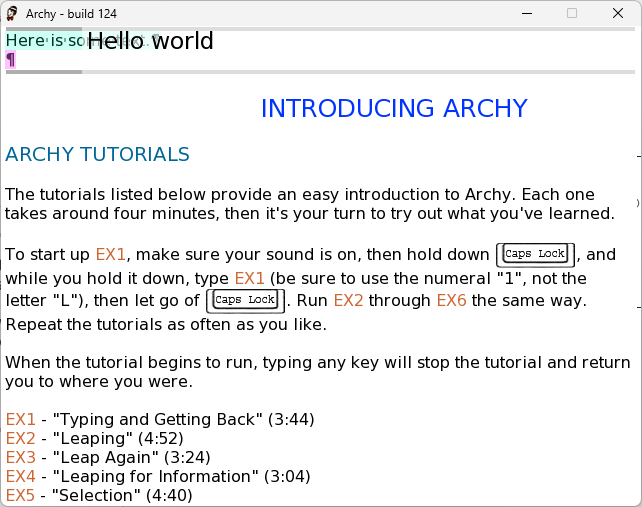
Here, we’ll take the LEAP command itself (which you can change, too!), select and copy it, and then use it as a template for a new one called TEST. This one will display a message to the user and insert a fixed string into the buffer. The command is ready right away; there is no need to restart the editor. We can immediately call it—its name is already part of command completion—and run it.
There are many such subsections and subdocuments. Besides the deletion document (now just called “DELETIONS”), your email is a document, your email server settings are a document, there is a document for formal Python modules which other commands can import, and there are several help documents. Each time you exit Archy, the entire workspace with all your commands, context, and settings is saved as a text file in the Archy folder with a new version number so you can go back to an old copy if you really screw up.
Every cul-de-sac ends
Although these are functional examples and some of their ideas were used (however briefly) in later products, we’ve yet to see them make a major return to modern platforms—but you can read all about that in the main article. Meanwhile, these emulations and re-creations give you a taste of what might have been, and what it could take to make today’s increasingly locked-down computer hardware devices more humane in the process.
Sadly, I think a lot of us would argue that they’re going the wrong way.
[ad_2]
Source link