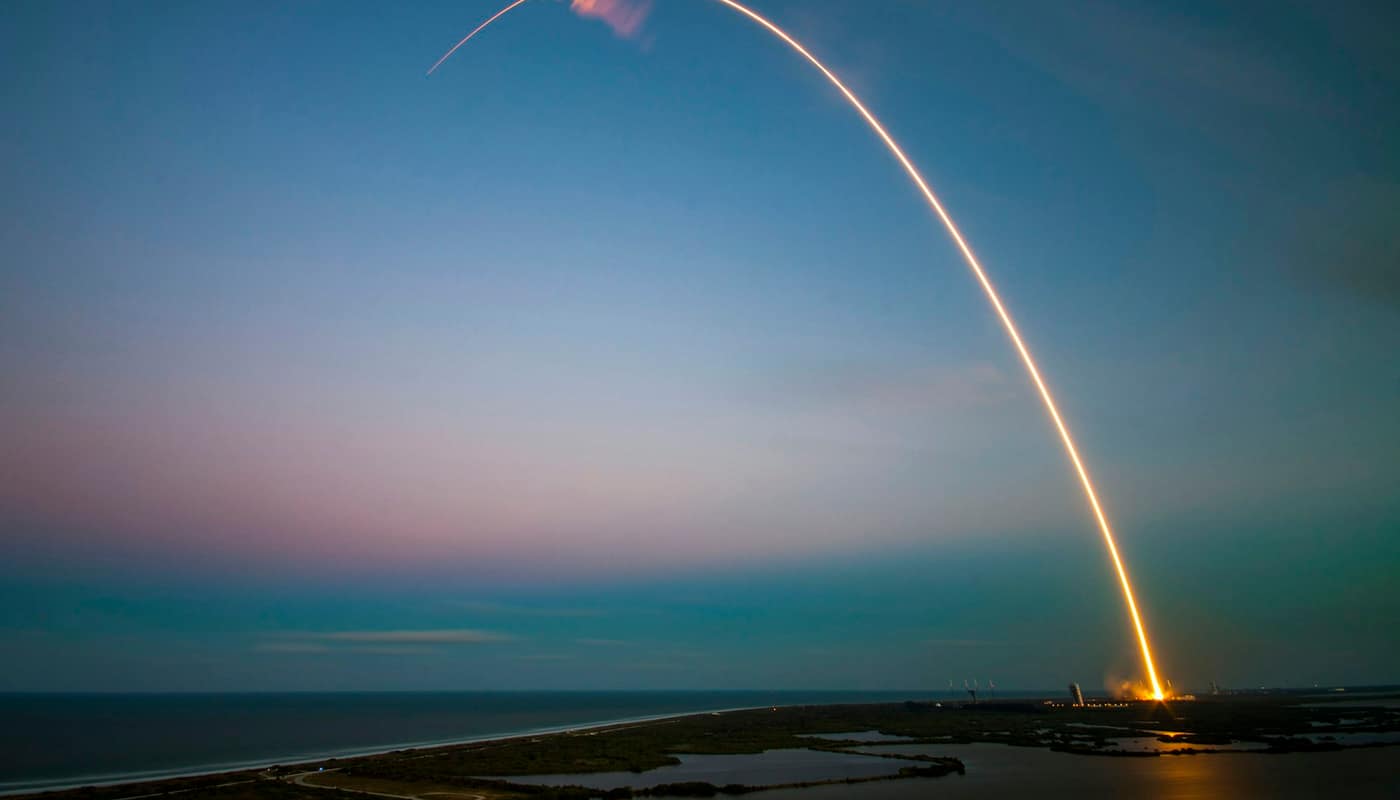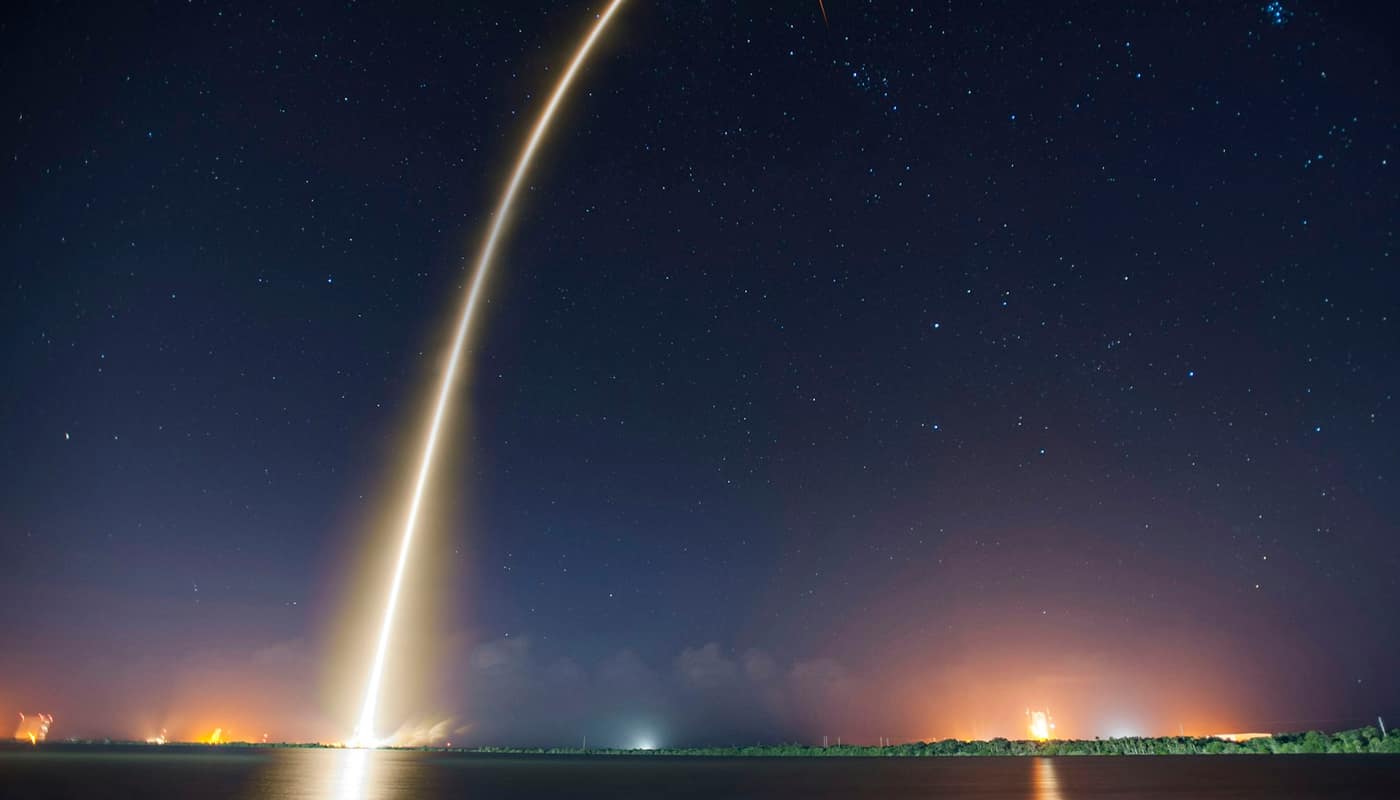
A rocket reaches orbit by rising above the dense atmosphere and then accelerating sideways until it is moving fast enough that it keeps falling around Earth instead of into it. For a low orbit, the European Space Agency (ESA) puts that speed at about 7.8 kilometers per second, or roughly 28,000 kilometers per hour.
Orbit is a sideways problem
Most people picture a launch as a straight climb, and the first minute or two does look that way. But going “up” is the easy part of getting to orbit. The hard part is the speed along the ground track, because that is what keeps a spacecraft from coming back down.
ESA describes the principle plainly: gravity pulls a satellite toward Earth, and the satellite’s sideways speed keeps it falling around the planet rather than into it. Rockets first lift the payload above the denser atmosphere, and their engines then provide the push that starts the orbit. Because there is almost no air friction at that height, ESA notes that gravity lets a satellite orbit with almost no further assistance.
Think of a ball thrown horizontally. The faster it is thrown, the farther it lands. Throw it fast enough, and the ground curves away beneath it as quickly as it falls. That is an orbit, and the required speed for a low one is the 7.8 kilometers per second above.
How fast is orbital speed, and how high is “orbit”?
Orbits come in families, and the numbers change with altitude. ESA’s overview of orbit types gives these reference points:
| Orbit | Altitude | Speed | Time for one loop |
|---|---|---|---|
| Low Earth orbit | Under 2,000 km | About 7.8 km/s | About 90 minutes |
| Geostationary orbit | 35,786 km | About 3 km/s | 23 hours 56 minutes 4 seconds |
Two details stand out. First, higher orbits are slower, not faster, which surprises many readers. Second, ESA notes that satellites generally do not fly below about 180 kilometers, because atmospheric effects would pull them down.
Orbital speed is also a very large number by everyday standards. A quick conversion shows why: 7.8 kilometers per second multiplied by 3,600 seconds in an hour is about 28,080 kilometers per hour, which matches the roughly 28,000 kilometers per hour NASA cites for orbit.
Why does a rocket have stages?
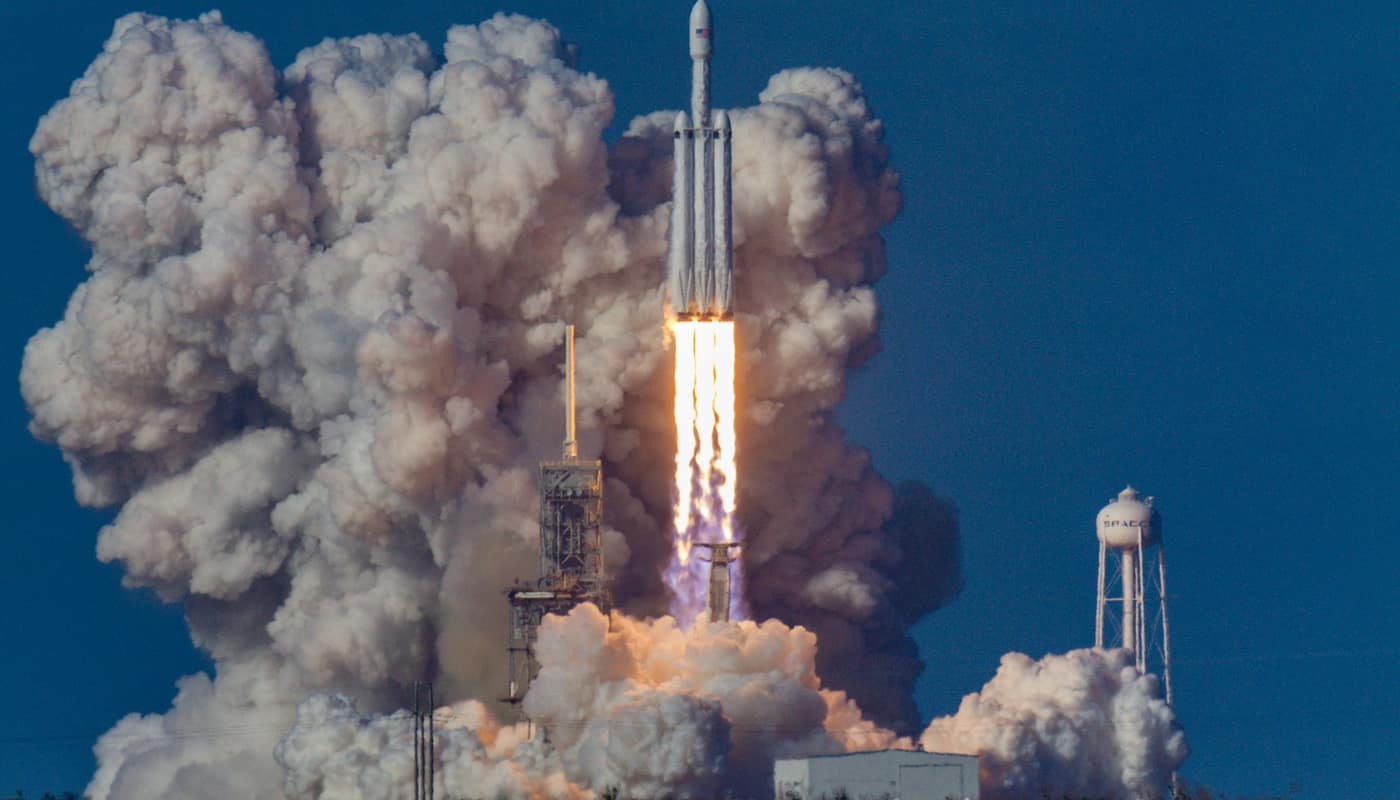
A rocket must accelerate its own fuel, and most of what sits on the pad is propellant and tank structure. Once a tank is empty, it is dead weight. Staging solves this by discarding empty parts so the remaining engines push less mass.
NASA’s description of the Saturn V shows the logic. On the Apollo version, the first stage had the most powerful engines because it had to lift the fully fueled vehicle off the ground, taking it to about 68 kilometers (42 miles). The second stage carried the rocket almost into orbit, and the third stage placed the Apollo spacecraft into Earth orbit and pushed it toward the Moon. Each stage burned until its fuel was gone, then separated, and the next stage’s engines fired. According to NASA, the first two stages fell into the ocean after separating.
The full Saturn V stood 111 meters (363 feet) tall and produced 34.5 million newtons (7.6 million pounds) of thrust at launch, per NASA. Most of that machine was fuel and structure that was progressively thrown away.
Solid, liquid and strap-on boosters
NASA’s launch guidance adds that many vehicles combine types of propulsion, such as solid rocket boosters strapped to a liquid-fueled rocket. A solid rocket cannot be shut down once lit, while liquid and hybrid engines can be shut down and, in some designs, restarted. That restart ability matters for upper stages, which often coast and then fire again to reach a precise orbit.
What does a typical ascent look like?
Details vary by vehicle, but the shape of a launch is similar, and NASA’s explanation of powered flight captures it: the vehicle is powered through the atmosphere until it reaches at least orbital velocity, powered flight ends when the last stage burns out, and the spacecraft separates and coasts.
In plain steps:
- Liftoff and climb. The first stage fights gravity and air resistance, pushing the vehicle upward through the thickest air.
- Pitch over. The rocket gradually tilts away from vertical toward the horizon. This is what turns a climb into a sideways acceleration.
- Stage separation. Spent stages are dropped, and the next stage ignites.
- Orbital burn. The upper stage keeps accelerating, mostly horizontally, until it reaches orbital speed.
- Engine cutoff and coast. The payload separates and travels in orbit under gravity alone.
Notice that most of the fuel goes into the speed, not the altitude. A rocket that only climbs and then falls back, as in a short suborbital hop, has not reached orbit even if it briefly touches space.
Why do launch sites matter?
Earth is spinning, and a launch can borrow some of that motion. NASA states that a site near the equator gains a speed boost of over 1,650 kilometers per hour relative to Earth’s center, which helps reach the roughly 28,000 kilometers per hour needed for orbit. In illustrative arithmetic, 1,650 divided by 28,000 is about 0.059, so the bonus covers roughly 6 percent of the required speed. A vehicle launched there would need less propellant, or could carry a heavier payload.
The direction of launch matters too. According to NASA, launches from Kennedy Space Center suit low-inclination orbits, because paths to high-inclination orbits would cross populated areas. High-inclination launches use Vandenberg Air Force Base on the west coast, where trajectories can run over the ocean. The same logic is why the rotation bonus is tied to the direction of the orbit: a launch into a high-inclination orbit gets no such free ride.
Timing also shapes planning. NASA notes that launch windows for interplanetary missions can span weeks, depending on Earth’s position in its orbit, and may narrow to certain hours of the day because of Earth’s rotation. Mission-specific details are covered in our explainer on how twin probes reach Mars after an Earth flyby.
Common misconceptions about reaching orbit
“Orbit means going high enough to escape gravity.” It does not. Gravity at orbital altitude is still strong. Objects in low orbit are falling continuously, and they stay up because they move sideways quickly. This is also why astronauts float: they and the spacecraft are in free fall together, not beyond gravity’s reach.
“Reaching space means reaching orbit.” Space is a matter of altitude. Orbit needs altitude plus a very large horizontal speed. A vehicle can pass the first test and fail the second.
“A rocket pushes against the ground or the air.” A rocket works by expelling exhaust in one direction and being pushed in the other, which is why it works in a vacuum. The air only gets in the way.
“Higher orbits are faster.” As the table above shows, the geostationary orbit at 35,786 kilometers moves at about 3 kilometers per second, far slower than a low orbit, though it takes much more energy to reach.
“Once in orbit, a satellite needs constant engine power.” ESA’s description points the other way. With little air at that height, a satellite keeps going with almost no further assistance. Small corrections are still needed, but not continuous thrust. Satellites at the lowest altitudes face more drag, which is part of why they rarely operate below about 180 kilometers.
What changes with the destination and the vehicle?
The same physics applies to every launch, but the plan changes with the goal. NASA’s launch guidance notes that interplanetary missions may park briefly in low Earth orbit before an upper stage sets them on their way, and that upper stages such as Centaur can be added to give a payload the performance it needs. Reaching a geostationary orbit typically means an extra step from a low orbit to a higher one, as ESA’s orbit overview implies by placing it so much farther out.
The vehicle matters as well. Saturn V used three stages for the Moon mission, but NASA notes that the Saturn V that launched Skylab had only two stages. Modern rockets also differ in whether parts come back: the first stage of some designs now returns to land and flies again, as we explain in our look at how reusable boosters land and fly again. Reuse changes the cost of reaching orbit, not the speed needed to stay there.
Once a payload is in orbit, what happens next depends on its job. Observatories such as the one in our guide to how the James Webb Space Telescope looks back in time rely on launches being reliable and precise far more than on any single number.
Speed is the real price of orbit
Reaching orbit comes down to three things: getting above most of the atmosphere, building about 7.8 kilometers per second of sideways speed for a low orbit, and shedding weight along the way so that the engines have a manageable job. Staging, clever launch-site choices and the direction of flight are all ways of making that speed attainable. The altitude is the visible part of a launch. The speed is the part that actually puts something in orbit.
This article is general information about spaceflight and is not a substitute for professional engineering advice.
Sources: European Space Agency; NASA